
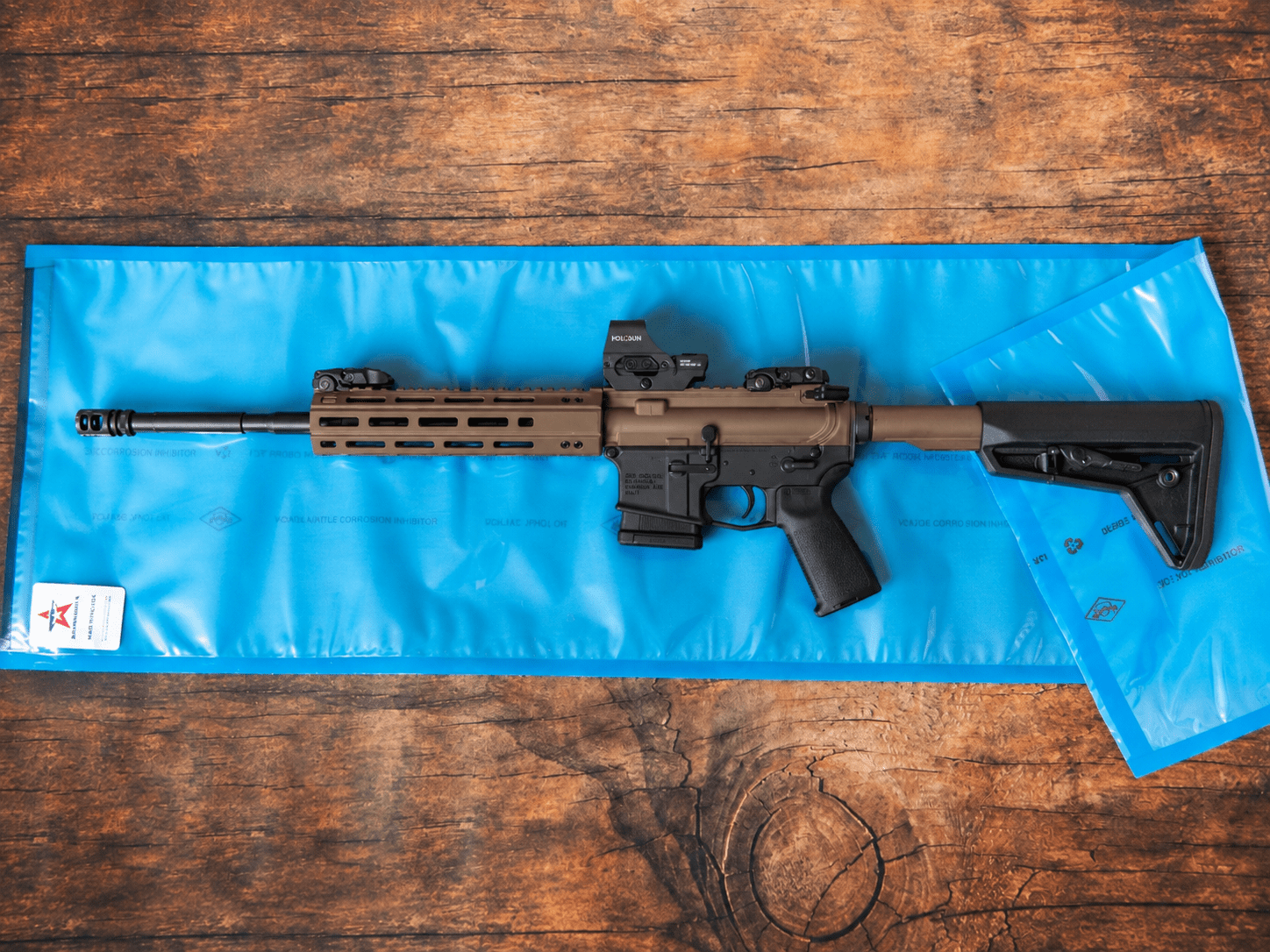
Buying VCI gun bags on sticker price alone is an easy way to spend more money. A cheaper single-layer bag looks like the better deal at checkout. Across a decade of storage, it usually is not.
This is the math on multi-layer VCI gun storage bags versus the single-layer bags sold elsewhere. The comparison covers replacement cycles, moisture barrier performance, packaging, and lifespan tracking.
Why cheap VCI gun bags cost more over ten years
Single-layer VCI bags are a single sheet of polyethylene with corrosion inhibitor blended into the resin. That one layer does two jobs at once. It has to release VCI vapor inside and block moisture from outside.
One layer cannot do both jobs well. Most single-layer gun bags on the market carry a rated protection life of two to five years, with three years being the common figure.
Arms Preservation Inc. builds bags differently. A dedicated VCI layer handles corrosion chemistry. A separate barrier layer blocks moisture and oxygen. A durable outer layer resists punctures and handling wear.
That construction is why API bags carry a 5 to 10 year service life. You can read the full breakdown of the layers on our how VCI gun bags work page.
The 10-year cost comparison for long gun storage bags
Here is the arithmetic on a rifle or shotgun bag. Single-layer prices below reflect current per-bag pricing from three suppliers, including their multi-pack discounts.
| Bag type | Cost per bag | Rated life | Bags needed for 10 years | 10-year cost |
|---|---|---|---|---|
| API multi-layer VCI Rifle Bag, 14" x 49" | $14.99 | 5-10 years | 1 to 2 | $14.99 - $29.98 |
| Single-layer 12" x 48" long gun bag (3-pack) | $5.33 | 3+ years | 4 | $21.32 |
| Single-layer 12" x 52" shotgun bag (3-pack) | $5.00 | ~3 years | 4 | $20.00 |
| Single-layer 12" x 42" rifle bag (3-pack) | $4.00 | ~3 years | 4 | $16.00 |
| Single-layer long gun bag sold individually | up to $7.95 | 2-5 years | 2 to 5 | $15.90 - $39.75 |
Every single-layer option in that table costs more across ten years than one API rifle bag. Even the cheapest three-pack lands above it once you buy the fourth replacement.
The gap widens on cost per year. An API rifle bag running its full service life works out to roughly $1.50 per year of protection. Comparable single-layer bags land between $1.67 and $3.98 per year.
Those figures are generous to the single-layer bags. They assume you use all three bags in a multi-pack at once, which requires three long guns.
Why a three-pack does not cover nine years
Multi-pack pricing looks like the obvious way to save money. Buy three bags, cover nine years, pay less per bag. The packaging invites that assumption.
It does not work that way. A VCI bag begins aging when it is manufactured, not when you finally put a firearm in it.
Single-layer bags ship loose in poly sleeves, tubes, or thin outer bags. Air reaches every bag in the pack, including the two you set aside for later.
Those bags off-gas on your shelf at the same rate as the one in service. When you reach for bag number two, it has already aged three years alongside bag number one.
Bag number three is in worse shape. It spent six years venting VCI vapor into a closet before it ever touched a firearm.
A three-pack does not give one rifle nine years of coverage. It gives you three bags that all expire around the same date.
What a three-pack really costs a single-firearm owner
Store one long gun and the spare bags age out before their turn arrives. Your real cost becomes the full pack price every three years.
| Storing one long gun for 10 years | What you actually buy | 10-year cost |
|---|---|---|
| API multi-layer VCI Rifle Bag, 14" x 49" | 1 to 2 bags | $14.99 - $29.98 |
| Single-layer 12" x 48" long gun bag | 4 three-packs | $63.96 |
| Single-layer 12" x 52" shotgun bag | 4 three-packs | $60.00 |
| Single-layer 12" x 42" rifle bag | 4 three-packs | $48.00 |
Every API bag ships vacuum sealed, so a spare stays inert until you open it. Buy two today and the second one is still factory fresh when its turn comes.
The costs that never show up on a receipt
Replacement cycles carry hidden expenses. Each swap means another order, another shipping charge, and another day your firearm sits unprotected.
There is also the risk you forget. A bag that quietly stopped working two years ago is worse than no bag at all, because you stopped checking.
MVTR: the number that determines how long a VCI bag protects
MVTR stands for Moisture Vapor Transmission Rate. It measures how much water vapor passes through a film in 24 hours, tested under ASTM F1249 conditions.
Lower numbers mean a better barrier. This one figure predicts VCI bag lifespan more reliably than thickness or price.
Measured MVTR: multi-layer barrier vs single-layer poly

| Material | Specification | MVTR (g/100 in²/day) | Vs. single-layer |
|---|---|---|---|
| API foil shielding barrier | MIL-PRF-81705E Type 1 | 0.0005 | 120x lower |
| API transparent barrier | MIL-PRF-22191F Type 1 | 0.010 | 6x lower |
| Single-layer 4 mil VCI poly | Typical ferrous-only film | 0.06 | Baseline |
API foil barrier film admits up to 120 times less moisture than a typical single-layer 4 mil VCI poly bag. Our transparent barrier still cuts moisture ingress by roughly six times.
The test conditions make that gap conservative. API barrier films were tested at 104°F, while the single-layer figure reflects testing at 73°F. Heat drives more vapor through any film, so the real-world spread is wider still.
Why single-layer film loses the fight
Polyethylene is permeable. Water vapor moves through it continuously, even at 4 mil thickness. Humidity keeps migrating inward toward your firearm.
The VCI chemistry inside fights that incoming moisture from day one. Every molecule spent on infiltrating humidity is one no longer available to protect steel.
API bags place a true barrier layer between outside air and the VCI layer. Far less moisture gets in, so the corrosion inhibitor lasts dramatically longer.
That difference is why one API bag can cover a decade instead of three years.
MVTR figures are typical published lab values, not guaranteed specifications.
Vacuum sealed packaging protects the bag before you own it
VCI chemistry begins releasing the moment the film meets open air. That process is called off-gassing, and it does not wait for you.
Most single-layer VCI gun bags ship loose. They arrive in a plain poly bag, a cardboard tube, or a simple sleeve. Every one of those packages breathes.
Those bags off-gas in the warehouse. They off-gas in the delivery truck. They off-gas on the retail shelf and in your closet before first use.
By the time a loose-packed bag goes to work, months or years of its VCI reservoir are already gone. You paid for a three-year bag and received something less.
This is also why the spare bags in a multi-pack are not fresh when their turn comes. They aged right alongside the first one.
Every API VCI gun bag ships vacuum sealed. No air reaches the film, so the VCI stays dormant until you open the package. Your protection clock starts when you start it.
A date label makes your storage program trackable
Here is a question most gun owners cannot answer. When did you first seal that bag?
Single-layer bags almost never include a way to record it. Without a date, you are guessing at whether a bag is at year two or year six.
Guessing leads to two bad outcomes. You either replace a bag that had years of life left, or you trust a bag that quit protecting a while ago.
Every API bag includes a printed label for recording the in-service date. Write it down once and your replacement schedule becomes a fact instead of a hunch.
For collections and armories, this matters even more. A dated label turns a pile of bags into an auditable inventory.
How to reach the full service life of a VCI gun bag
Bag construction sets the ceiling. Your handling determines whether you reach it.
- Clean and fully dry the firearm before it goes in the bag.
- Seal the closure completely along its entire length.
- Open the bag as rarely as possible, since each opening vents VCI vapor.
- Store in a stable location away from extreme temperature swings.
- Record the in-service date on the bag label immediately.
Our step-by-step VCI storage bag instructions cover each step in detail.
Frequently asked questions about VCI gun bags
How long do VCI gun bags last?
It depends entirely on construction. Multi-layer VCI gun bags from Arms Preservation Inc. are rated for 5 to 10 years of protection. Single-layer bags are typically rated for two to five years. Storage conditions and how often you open the bag both affect real-world results.
Are multi-layer VCI gun bags worth the higher price?
Over a single season, the cheaper bag wins on price. Over ten years, the multi-layer bag wins on total cost. One API rifle bag at $14.99 covers a decade, while comparable single-layer bags total $16.00 to $39.75 across the same period.
The gap grows if you own one long gun. A three-pack cannot be spread across nine years, because all three bags age from the date they were made. Replacing a pack every three years costs $48.00 to $63.96 over a decade.
What is MVTR and why does it matter for gun storage bags?
MVTR measures how much moisture passes through the bag film in 24 hours under ASTM F1249 testing. Lower is better. API foil barrier film tests at 0.0005 g/100 in²/day, against roughly 0.06 for a typical single-layer 4 mil VCI poly bag. That is up to 120 times less moisture reaching your firearm.
Why do vacuum-sealed VCI bags outlast loose-packed bags?
VCI film starts releasing corrosion inhibitor as soon as it contacts air. Bags shipped loose in poly bags or tubes off-gas during warehousing, shipping, and shelf time. Vacuum sealing keeps the film inert until you open it, so no service life is lost before first use.
Choose a VCI gun bag built for the long haul
Rust does not take years off. Neither should your storage bag.
Arms Preservation Inc. builds multi-layer VCI gun bags in the USA, vacuum seals every one, and labels each bag so you can track it. Browse our best-selling VCI gun storage bags to find the right size for your pistols, rifles, shotguns, and ammo.
Still deciding? Our VCI FAQ answers the most common questions about long-term firearm storage.
1 comment
What do I need to do to my 5 rifles and five hand guns before using your VCI bags? Should they be treated with a T-9 or equivalent?