
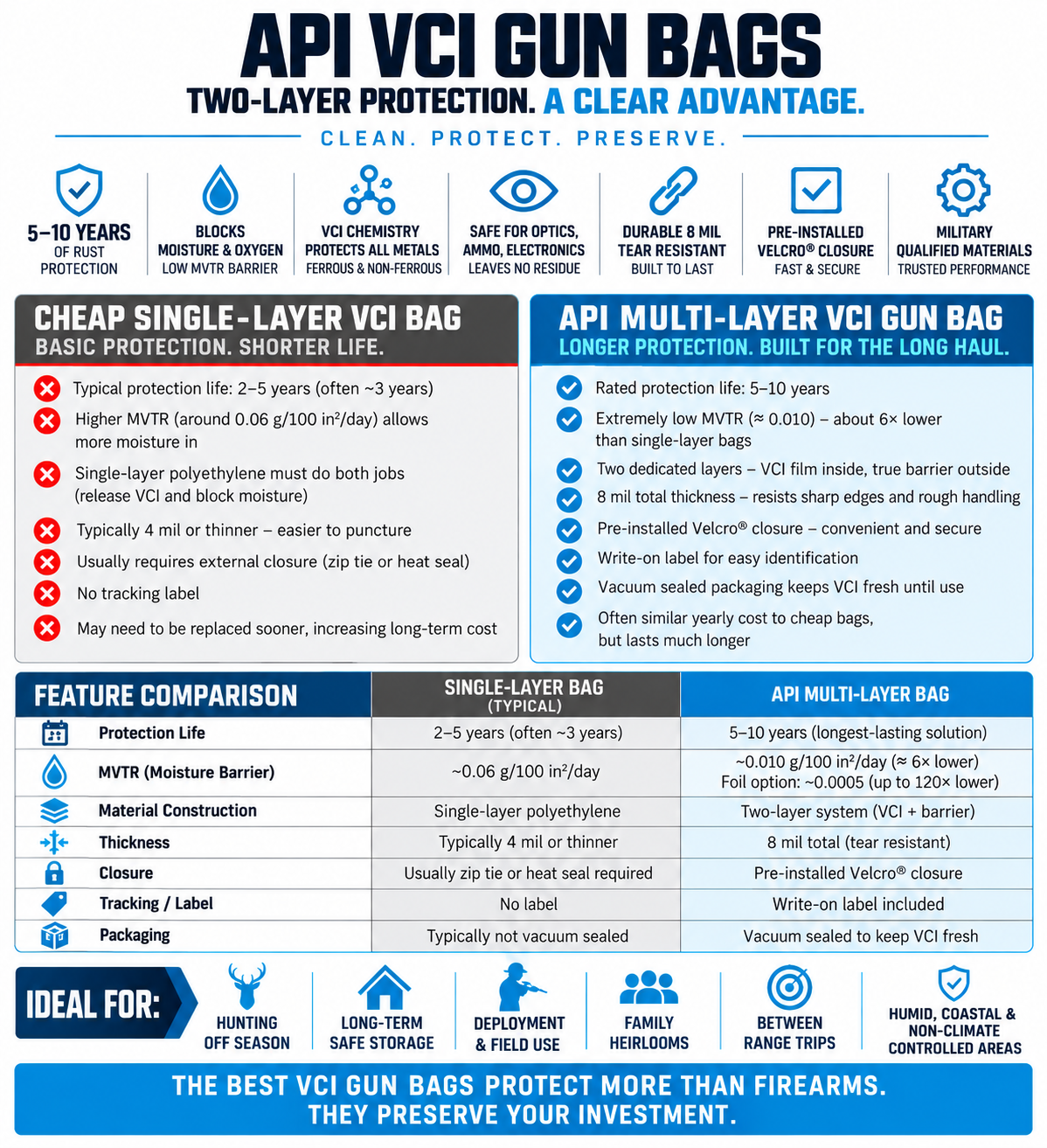
The best VCI gun bags are not always the cheapest ones on the shelf. At a glance, a bargain single-layer bag and a multi-layer bag from Arms Preservation Inc. (API) look a lot alike. Inside a gun safe, however, they perform very differently.
This guide breaks down the features that actually stop rust. It also shows why those features matter more than the price tag. Use it as your checklist before you buy any VCI gun bag.
Quick answer: Judge a VCI gun bag by its protection life, moisture barrier (MVTR), materials, thickness, closure, and tracking label. API bags pair military-qualified VCI film with a low-MVTR barrier, a pre-installed Velcro® closure, and a write-on label. The result is 5 to 10 years of rust protection, often for about the same yearly cost as a cheap bag.
In this guide:
- Why features matter more than price
- 6 features that set the best VCI gun bags apart
- Single-layer vs API comparison table
- What a cheap VCI bag really costs
- Range-ready storage without cosmoline
- VCI gun bag FAQs
What makes the best VCI gun bags worth it?
Features make them worth it. Price only tells you what you pay today. Features tell you how long your firearm stays protected and how often you have to start over.
Think about how you actually store guns. After all, most firearms in a safe sit for years, not weeks. So the real question is not which bag costs less. Instead, ask which bag will still protect your gun in year five.
A cheap single-layer bag can handle a few months of seasonal storage. For anything longer, though, the six features below decide whether your gun comes out clean or spotted with rust.
6 features that set the best VCI gun bags apart
Use these six features as your buying checklist for the best VCI gun bags. Each one affects how long a bag can protect your firearm. Each one is also where API pulls ahead of basic single-layer bags.
1. Protection life: the longest-lasting VCI storage solution
Start with the rated protection life, because it sets the ceiling for everything else. Most basic single-layer VCI bags carry a two to five year rating, and three years is common.
API engineered its bags to be the longest-lasting VCI storage solution available. In fact, API rates its VCI gun bags for 5 to 10 years of rust prevention. Actual results depend on your storage conditions and how often you open the bag.
API also ships each bag vacuum sealed, so the VCI chemistry stays fresh until you open the package. As a result, your protection window starts the day you seal your firearm inside.
2. Unmatched MVTR: the moisture number that matters most
MVTR stands for moisture vapor transmission rate. It tells you how much water vapor can pass through a film in a given area over a given time. Labs measure it with standard methods such as ASTM F1249. A lower number means a drier bag.
API's clear barrier layer (MIL-PRF-22191F Type 1) has an MVTR of about 0.010 g/100 in²/day. However, a typical single-layer 4 mil VCI poly bag is around 0.06. That makes API's barrier roughly six times more resistant to moisture.
API's foil barrier, used on its MIL-PRF-81705 bags, goes even further at about 0.0005. That is up to 120 times lower than single-layer poly. So single-layer bags simply cannot match those numbers.
A low MVTR also keeps VCI vapor inside the bag, where it protects your firearm instead of drifting into your safe. The test conditions widen the gap, too. API's figures come from testing at 90% humidity and 104°F, while many single-layer films use a milder 73°F rating.
MVTR figures are typical published lab values, not guaranteed specifications.
3. Material combinations: VCI film plus a true barrier
A single-layer bag asks one sheet of plastic to do two jobs. It must release corrosion inhibitor inside while it also blocks moisture from outside. Because polyethylene is permeable, humidity keeps creeping in and using up the VCI.
API splits those jobs between dedicated layers:
- Inside layer: Cortec VpCI-126 MIL film, qualified to MIL-PRF-22019D Type 1, protects ferrous and non-ferrous metals.
- Outside layer: A MIL-PRF-22191F Type 1 barrier slows moisture and oxygen and helps hold VCI vapor in.
- Combined wall: Together, the layers form 8 mil of protection that stands up to rough handling.
Since each layer has one job, each layer can do that job well. To see the chemistry in action, visit our How VCI Gun Bags Work page.
4. Thickness that resists sharp edges
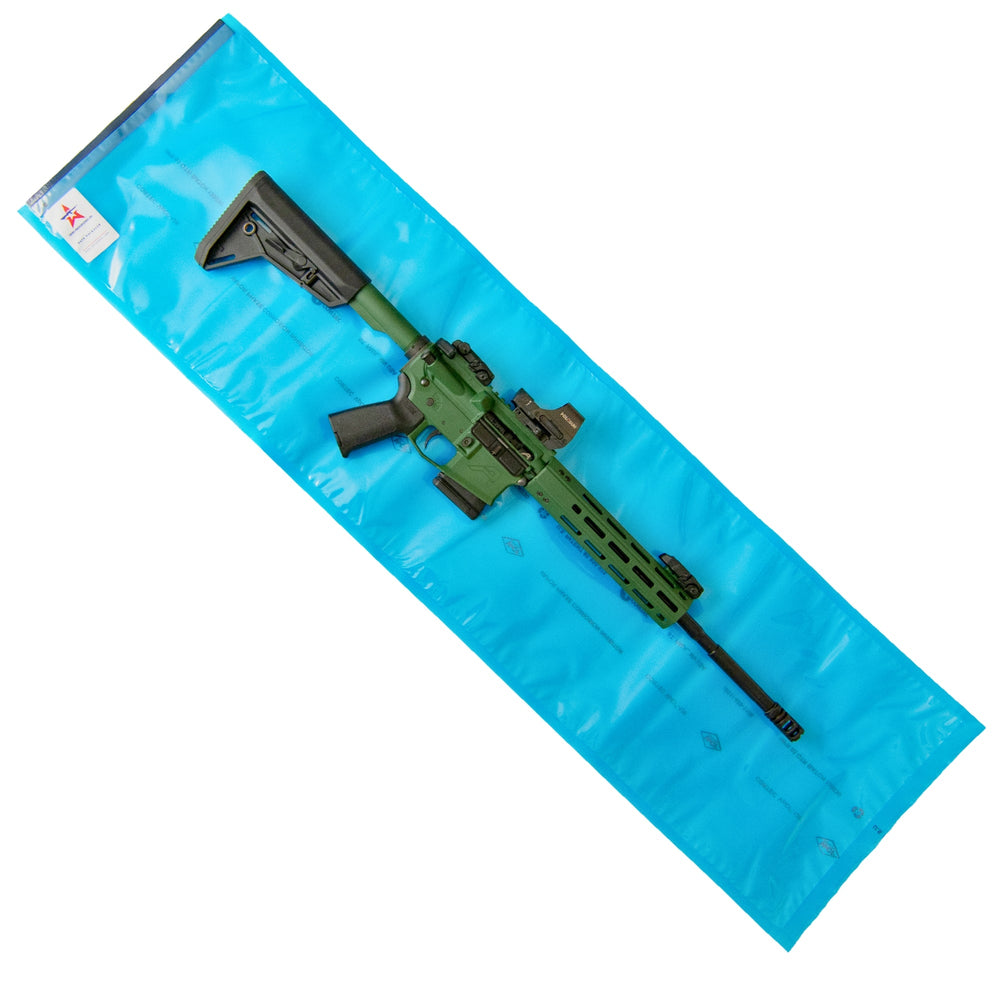
Many single-layer gun bags are 4 mil thick or thinner. That is thin enough for a front sight to poke through as you slide a rifle inside. Charging handles, bolt handles, muzzle devices, and Picatinny rails can snag thin film, too.
That matters because one small puncture breaks the seal. After that, humid air flows in and VCI vapor leaks out. API's 8 mil multi-layer construction resists those snags, so the protective atmosphere stays intact for the long haul.
5. A pre-installed Velcro® closure
Basic bags often leave the sealing up to you. That can mean tape, zip ties, a heat sealer, or a simple fold that loosens over time.
API VCI gun bags arrive with a pre-installed Velcro® hook-and-loop closure. It closes the bag in seconds and reopens just as fast. You get a dependable seal without extra tools, and you can reuse the bag after every inspection or range trip.
For the best seal, press the closure flat along its full length. Our VCI storage bag instructions walk you through each step.
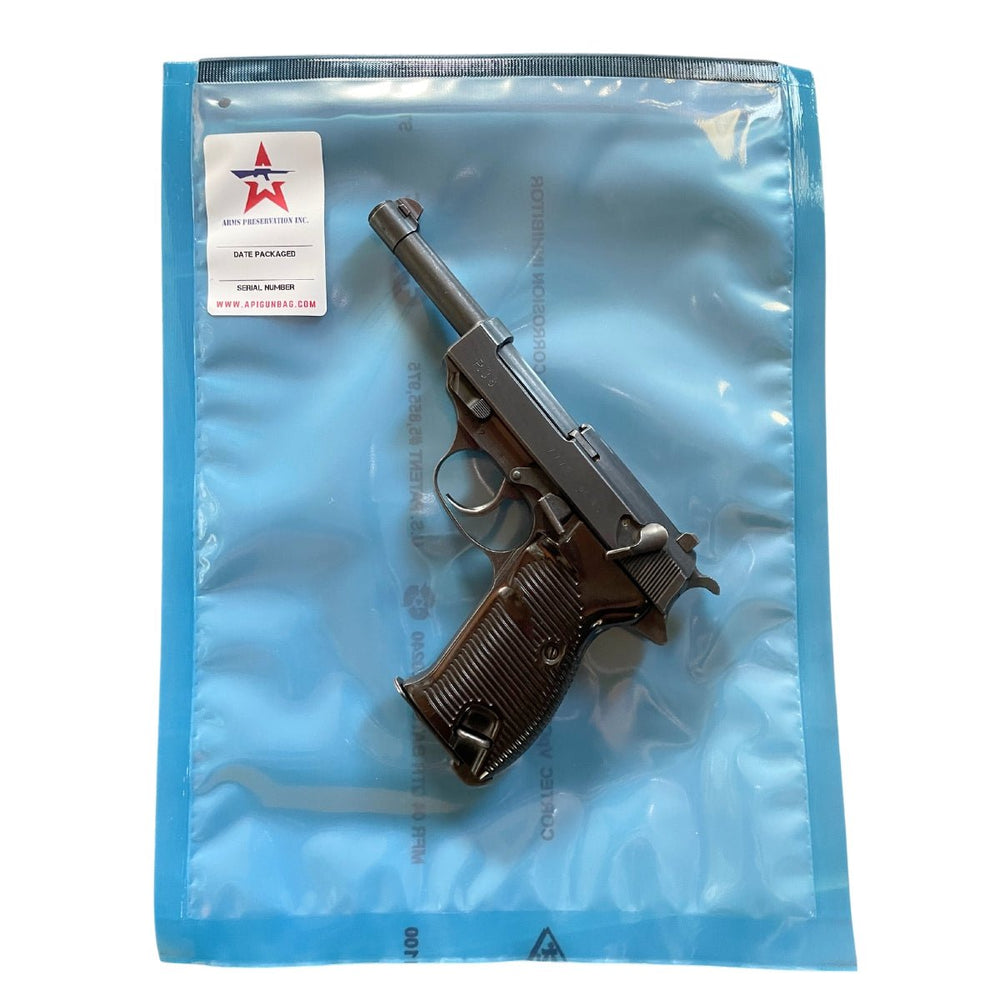
6. Labels that track bag lifespan and contents
Here is a quick test. When did you seal the rifle in the back of your safe? Most owners can only guess, and single-layer bags rarely include a way to record it.
API bags, however, include a write-on label. Simply record the date you sealed the bag and what is inside. Now you know exactly when each bag nears the end of its 5 to 10 year window.
Labels protect your firearms, too. Every time you open a bag to check its contents, some VCI vapor escapes. A clear label lets you identify each gun without breaking the seal. For collectors and armories, it also turns a stack of bags into a trackable inventory.
Single-layer VCI bags vs API VCI gun bags
Here is how the two options compare, feature by feature.
| Feature | Typical single-layer VCI bag | API VCI gun bag |
|---|---|---|
| Construction | One sheet of VCI poly | Dedicated VCI layer plus a barrier layer |
| VCI film | Varies; often ferrous-only | Cortec VpCI-126 MIL (MIL-PRF-22019D Type 1) |
| Barrier MVTR (g/100 in²/day) | About 0.06 | About 0.010 (foil bags: 0.0005) |
| Thickness | Often 4 mil or less | 8 mil multi-layer |
| Rated protection | Typically 2 to 5 years | 5 to 10 years |
| Closure | Often tape, zip ties, or a heat seal | Pre-installed Velcro® closure |
| Tracking label | Rarely included | Write-on date and contents label |
| Packaging | Often shipped loose | Vacuum sealed until first use |
| Made in | Varies | USA |
Price vs value: what a cheap VCI bag really costs
At checkout, the cheaper bag always wins. Over ten years of storage, however, the math looks very different.
Take a basic single-layer rifle bag at about $6, rated for roughly three years. To cover a decade, you need four of them. That adds up to about $24, plus four rounds of unpacking, inspecting, and re-bagging.
Now consider API's 14" x 49" rifle bag at $14.99, rated for 5 to 10 years. In the best case, one bag covers the full decade and saves you about $9. Even in the worst case, two bags total $29.98. That is roughly 60 cents a year more for a barrier that lets in about six times less moisture.
Then add the costs that never show up on a receipt. Every swap means another order and another gap in protection. Worse, a bag that quietly expired last year gives you false confidence.
For the full math, see our 10-year cost comparison of multi-layer vs single-layer VCI gun bags.
The lesson is simple. When you choose protection, compare features first. Price only matters once the features are equal, and with VCI gun bags they rarely are.
How the best VCI gun bags replace cosmoline and grease
Decade-long storage once meant packing a firearm in cosmoline or heavy grease. It worked, but cleanup took hours of scrubbing the bore, action, and small parts.
A long-lasting VCI gun bag replaces that mess for up to ten years. Inside the sealed bag, VCI molecules form an invisible protective layer on exposed metal, including the bore, chamber, and action. When you remove the firearm, that layer simply dissipates.
So you can store a clean, dry, lightly oiled gun and pull it out ready for the range. API bags are also safe for optics, wood stocks, polymer frames, and common finishes. One tip: place the firearm directly in the bag, never inside a gun sock, because fabric can hold moisture against the metal.
Best VCI gun bags: frequently asked questions
Are the best VCI gun bags worth the higher price?
Yes, for anything longer than a season. API bags cost more upfront, but their 5 to 10 year rating means fewer replacements. Over a decade, you often pay about the same or less, and you get far better moisture protection the entire time.
What MVTR should I look for in a VCI gun bag?
Look for the lowest published MVTR you can find. API's clear barrier tests at about 0.010 g/100 in²/day, and its foil barrier at about 0.0005. In contrast, a typical single-layer 4 mil VCI poly bag sits around 0.06.
Can I reuse a VCI gun bag after I open it?
Yes. API's pre-installed Velcro® closure reseals in seconds, so you can open the bag for an inspection or a range day and seal it again. Each opening releases a little VCI vapor, so open bags only when needed.
Do I need oil or a desiccant inside a VCI gun bag?
You do not need heavy oil or grease. Just clean the firearm, let it dry completely, and add a light coat of quality gun oil if you like. A desiccant is optional, because the VCI film and barrier layer provide the primary protection.
Shop the best VCI gun bags for long-term storage
Cheap bags save a few dollars today. The best VCI gun bags protect your firearms for years.
Arms Preservation Inc. builds every VCI gun bag in the USA. Each one combines military-qualified VCI film, a low-MVTR barrier, a pre-installed Velcro® closure, and a write-on tracking label. Browse our best-selling VCI gun storage bags to find the right fit for your pistols, rifles, shotguns, and gear.
0 comments