
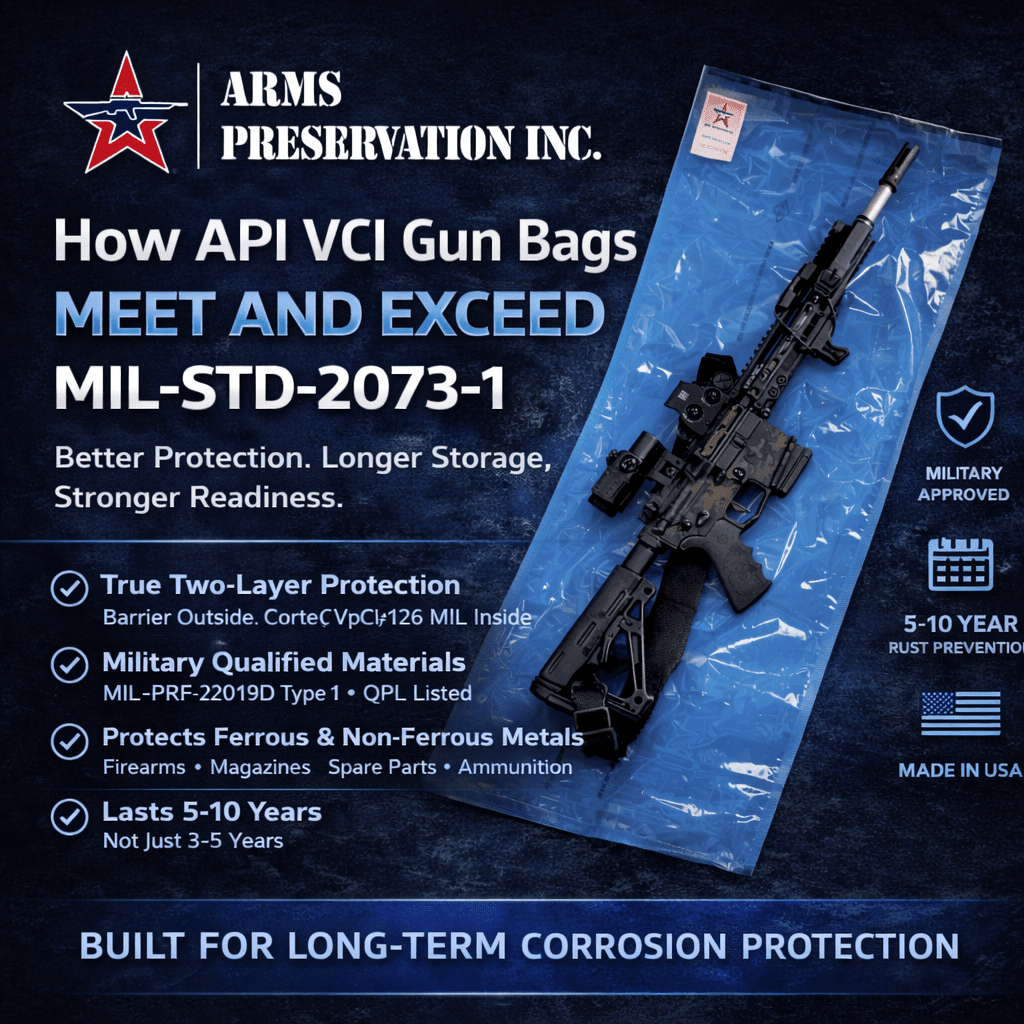
Why MIL-STD-2073-1 Matters for Weapon Storage
MIL-STD-2073-1 is not just about wrapping an item in plastic. It is a military packaging standard focused on protecting material during storage, handling, and shipment.
That matters when comparing API to basic VCI bag manufacturers. A bag that only adds VCI chemistry can help. A bag that also adds barrier performance, durability, and better handling protection does more.
API Uses a Stronger Two-Layer Preservation System
A true outer barrier layer adds real protection
API VCI Gun Bags use two 4 mil layers for a total thickness of 8 mil. The outer 4 mil layer is a flexible barrier material that helps block oxygen, moisture, and outside environmental exposure.
It also helps hold the protective VCI atmosphere inside the bag. That is a major advantage over many basic VCI bags that rely on one layer of VCI poly alone.
The inner layer is Cortec VpCI-126 MIL film
API uses Cortec VpCI-126 MIL film on the inside layer. This MIL version is a transparent blue film designed for multimetal corrosion protection.
It is qualified to MIL-PRF-22019D Type 1 and confirmed by the Naval Air Warfare Center Aircraft Division. It is a widely used, military-approved corrosion-inhibiting film designed for long-term packaging.
It meets strict standards for protecting ferrous and non-ferrous metals. It is also approved for use by major aerospace manufacturers.
Military Specification: MIL-PRF-22019D Type 1.
Qualified Product Listing: QPL 13600 Ser 43500B120-3/531.
Standards and references include TO 1-1-686, TM 55-1500-331-34, NAVAIR 15-01-4, and NACE Standard RP0487-2000.
How API Better Supports MIL-STD-2073-1 Than Basic VCI Bags
Better protection against corrosion and moisture
API’s barrier outer layer helps reduce the movement of oxygen and water vapor into the bag. The inner Cortec VCI layer protects metal surfaces inside the sealed space.
That two-part system is more complete than a basic VCI bag that depends only on VCI poly film. API gives you both barrier protection on the outside and active corrosion inhibition on the inside.

Better support for handling, storage, and shipment
API’s total 8 mil construction adds durability and helps reduce dings and scratches in safes, cages, racks, and storage areas. That added durability matters during repeated handling and shipment.
Many competing VCI bags focus mainly on corrosion chemistry. API adds corrosion control, moisture resistance, and better physical protection in one reusable package.
Longer service life than many basic VCI bags
API VCI Gun Bags are designed to provide 5-10 years of rust prevention with proper use and storage conditions. Many single-layer VCI bags on the market typically offer only 3-5 years, depending on the brand.
That difference matters for armories, collectors, museums, law enforcement, and military users. A longer service window means fewer bag changes, less labor, and more confidence in long-term storage readiness.
Why Cortec VpCI-126 MIL Strengthens the API Advantage
API’s inner layer is built around a military-recognized corrosion-inhibiting film, not a generic VCI additive. Cortec VpCI-126 MIL is a transparent blue film designed for multimetal protection.
That makes API bags a strong choice for firearms, magazines, spare parts, and ammunition storage. The material protects both ferrous and non-ferrous metals, including aluminum, carbon steel, copper, and brass.
Why API Is the Better Choice for Military-Style Preservation
If your goal is simple short-term rust prevention, a basic VCI bag may be enough. If your goal is stronger preservation performance that better supports MIL-STD-2073-1 storage and shipment objectives, API offers more.
API combines barrier protection, Cortec MIL-grade VCI chemistry, greater thickness, and longer service life in one system. That is why API VCI Gun Bags stand apart from basic VCI bag manufacturers.
How To Get the Full 5-10 Year Benefit
Start with a clean, dry firearm or metal item. Seal the bag fully. Limit unnecessary openings. Store the bag in a stable location. These steps help maintain the protective microenvironment inside the bag.
To learn more, read How VCI Gun Bags Work.
For best practices, follow the VCI Storage Bag Instructions.
You can also browse the Best Selling Collection to choose the right size for your application.
FAQs About API VCI Gun Bags
What does MIL-STD-2073-1 mean for a VCI gun bag?
MIL-STD-2073-1 is a military packaging standard. It focuses on protection against corrosion, deterioration, handling damage, and shipment damage. API supports those goals better than basic single-layer VCI bags because it adds both barrier protection and VCI chemistry.
How long do API VCI Gun Bags last?
API VCI Gun Bags are designed to provide 5-10 years of rust prevention with proper use and storage conditions. Performance depends on the environment and how often the bag is opened.
What makes API different from many competing VCI bags?
API combines a 4 mil outer barrier layer with a 4 mil inner Cortec VpCI-126 MIL layer. That creates an 8 mil two-layer system built for longer storage, better moisture resistance, and stronger overall preservation performance.
Are API bags only for firearms?
No. API bags are also useful for magazines, spare parts, and ammunition-related storage because the Cortec VCI material protects both ferrous and non-ferrous metals.
CAGE Code: 99BK6
UEI: JPW3LBSNWLN5
DUNS: 010506258
EIN: 86-2355901
0 comments