
Not all VCI gun bags are built the same. Most are a single layer of 4-mil polyethylene. Arms Preservation Inc. (API) builds something different: a multi-layer system that pairs multi-metal VCI film with a true MIL-SPEC moisture barrier.
The result is measurably stronger moisture protection, higher puncture strength, and VCI chemistry that stays sealed inside the bag. Below, we break down the published test data behind that difference.

Inside API's Multi-Layer VCI Gun Bag Construction
Every API VCI gun bag combines engineered layers, and each layer has a separate job.
- Inner layer: multi-metal VCI film. This layer releases vapor corrosion inhibitor molecules that settle on every exposed metal surface, including the bore, chamber, and action.
- Outer layer: MIL-SPEC barrier film. A transparent MIL-PRF-22191F Type 1 barrier, or a foil-based MIL-PRF-81705E Type 1 shielding barrier, blocks outside moisture and locks VCI vapor inside.
Compare that to a standard VCI weapon bag. There, one extruded layer of 4-mil poly is asked to do every job at once. You can see the full process on our How VCI Gun Bags Work page.
MVTR: The Moisture Number That Decides Whether Your Gun Rusts
What Is MVTR?
MVTR stands for moisture vapor transmission rate. It measures how much water vapor passes through a packaging film every 24 hours, tested per ASTM F1249.
Lower MVTR means a drier micro-environment inside the bag. For stored firearms, drier means far less fuel for rust.
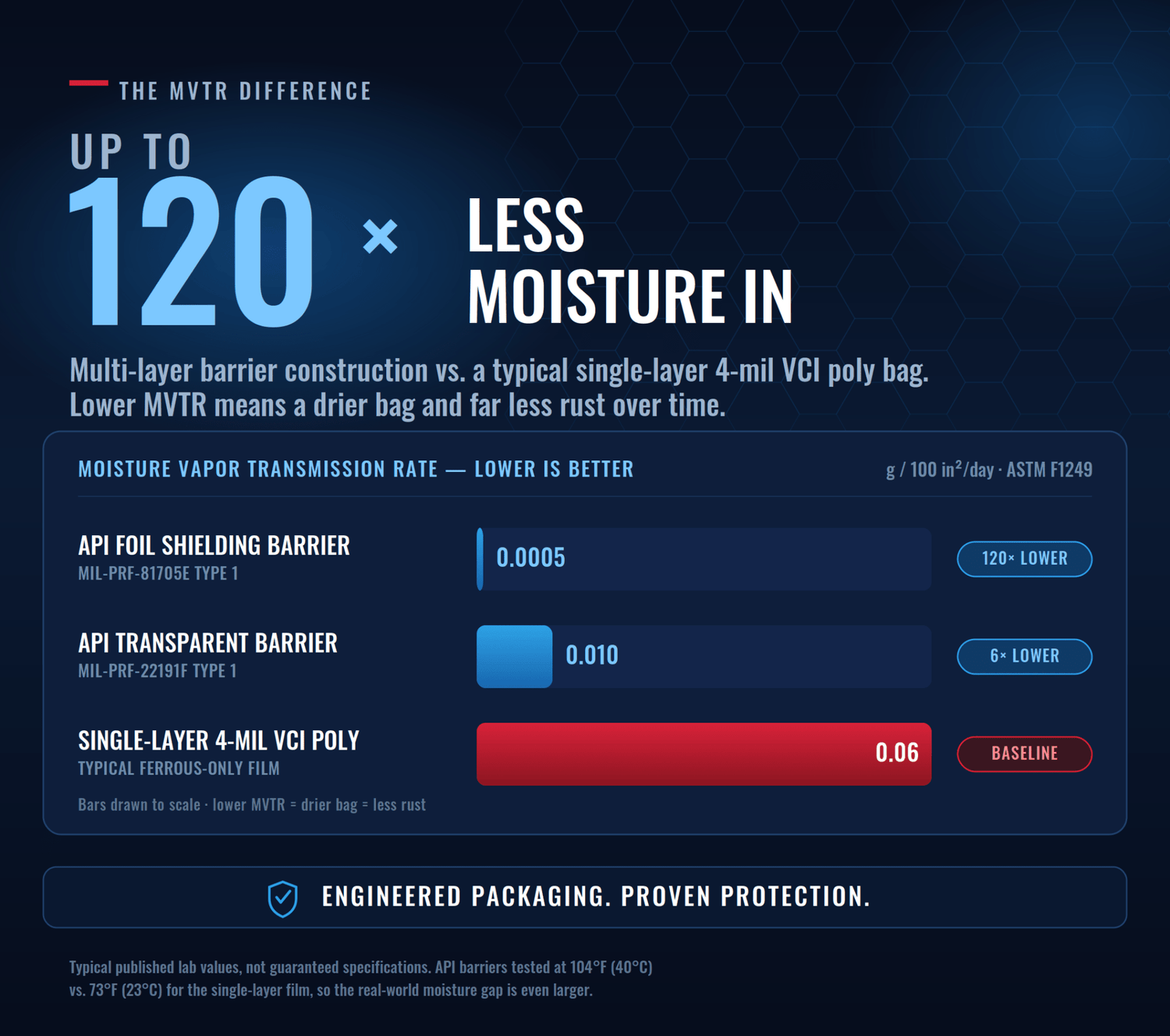
Published MVTR Data: Up to 120x Less Moisture Gets In
| Bag construction | MVTR (ASTM F1249) | Test conditions |
|---|---|---|
| API transparent barrier (MIL-PRF-22191F Type 1) | 0.010 g/100 in²/day | 90% RH at 104°F (40°C) |
| API foil shielding barrier (MIL-PRF-81705E Type 1) | 0.0005 g/100 in²/day | 90% RH at 104°F (40°C) |
| Typical single-layer 4-mil VCI poly weapon bag | 0.06 g/100 in²/day | 90% RH at 73°F (23°C) |
The data is not close. API's transparent MIL-PRF-22191F Type 1 barrier transmits 6 times less moisture than a leading single-layer 4-mil VCI film. Our foil shielding barrier transmits 120 times less.
And the gap is actually understated. API's barriers were tested at a punishing 104°F, while the single-layer film was tested at a mild 73°F. Moisture moves through plastic faster as temperature rises.
In a humid garage, a coastal safe, or a hot attic, that difference compounds every single day. This is how API VCI gun bags protect reliably across a far wider range of storage environments.
Safe for Both Ferrous and Non-Ferrous Metals
Many single-layer VCI weapon bags ship with ferrous-only chemistry. That formulation targets iron and steel, but it is not designed for the other metals on a modern firearm.
API VCI gun bags use multi-metal VCI chemistry instead. It protects carbon steel, stainless steel, cast iron, aluminum, brass, copper, and galvanized finishes.
So one bag safely covers an aluminum-framed pistol, a blued shotgun, brass-cased ammunition, and copper-jacketed components. For handguns, start with our VCI pistol storage bag, sized for full-size and compact frames.
Barrier Layers Lock VCI Molecules Inside the Bag
VCI protection only works while inhibitor molecules remain concentrated around your firearm. Here is the problem with single-layer poly: VCI vapor permeates polyethylene over time, just like moisture does.
That means a single-layer VCI bag off-gasses in both directions. Some molecules protect your firearm. The rest escape into the surrounding atmosphere, wasted, which steadily drains the bag's effective lifespan.
API's MIL-SPEC barrier layer changes the equation. It blocks outward vapor loss, so API bags off-gas in only one direction: into the bag, onto your firearm.
More inhibitor stays where it matters, for longer. That retention is a core reason API multi-layer VCI gun bags deliver 5+ years of rust prevention when sealed and stored correctly.
MIL-STD-3010 Puncture Strength: Built for Real-World Storage
A moisture barrier only works until the first hole. That is why API's barrier laminates are puncture-tested to MIL-STD-3010, the military's test standard for flexible barrier materials.
- Transparent MIL-PRF-22191F Type 1 barrier: 21 lbs puncture resistance (MIL-STD-3010).
- Foil MIL-PRF-81705E Type 1 barrier: 19 lbs puncture resistance (MIL-STD-3010).
Standard single-layer VCI poly bags are typically rated by dart-drop impact instead, around 300 grams for 4-mil film. Most never publish a MIL-STD-3010 puncture value at all.
Our multi-layer laminates also post tensile strength above 4,000 psi (ASTM D882). Published values for leading 4-mil VCI poly films sit near 3,000 psi. Sharp safe edges, muzzle crowns, and rough handling are exactly why that margin matters.
What This Means for Gun Owners and Armorers
Every specification above translates into practical, everyday value.
- A wider range of safe storage environments. Damp basements, coastal homes, unheated cabins, vehicle storage, and long deployments all stay inside the bag's protective envelope.
- Longer protection per bag. Locked-in VCI delivers 5+ years of rust prevention, while typical single-layer poly bags advertise around 3 years.
- Every metal covered. No guessing whether a bag's chemistry is safe for aluminum frames, brass, copper, or stainless parts.
- Clean, ready firearms. No grease, no cosmoline, no degreasing. Unseal, inspect, and head to the range.
Fewer replacement bags, no rust repairs, and no refinishing bills. That is real long-term value per dollar, not just a lower sticker price.
Frequently Asked Questions About VCI Gun Bags
How long do VCI gun bags protect a firearm?
API multi-layer VCI gun bags provide 5+ years of rust prevention with proper use. Typical single-layer poly bags advertise around 3 years, partly because escaping VCI vapor depletes them faster.
Do I need to oil my gun before using a VCI gun bag?
No. Store the firearm clean and dry; a light oil coat is optional. Follow our VCI storage bag instructions for step-by-step guidance.
Are VCI gun bags safe for optics, wood stocks, and polymer?
Yes. API's VCI chemistry is designed for firearm storage and is commonly used with optics, wood, polymer, and standard metal finishes. It leaves no residue when the firearm comes out.
Can I reuse an API VCI gun bag?
Yes. Inspect the bag for punctures, then reseal it tightly after each opening. Because the barrier locks VCI inside, the remaining protection is preserved between uses.
Upgrade From Single-Layer Poly to Multi-Layer Protection
Single-layer VCI bags were a good first step. Multi-layer barrier protection is the upgrade your collection deserves. Shop our American-made, best-selling VCI gun bags and seal in 5+ years of protection.
Performance figures reflect typical published laboratory values for the materials described, not guaranteed specifications. Real-world results vary with storage conditions, surface cleanliness, and how often the bag is opened.
0 comments